Monday, July 1, 2013

Cocoa-sta Rica (Cocoa in Costa Rica)

Cacao tree
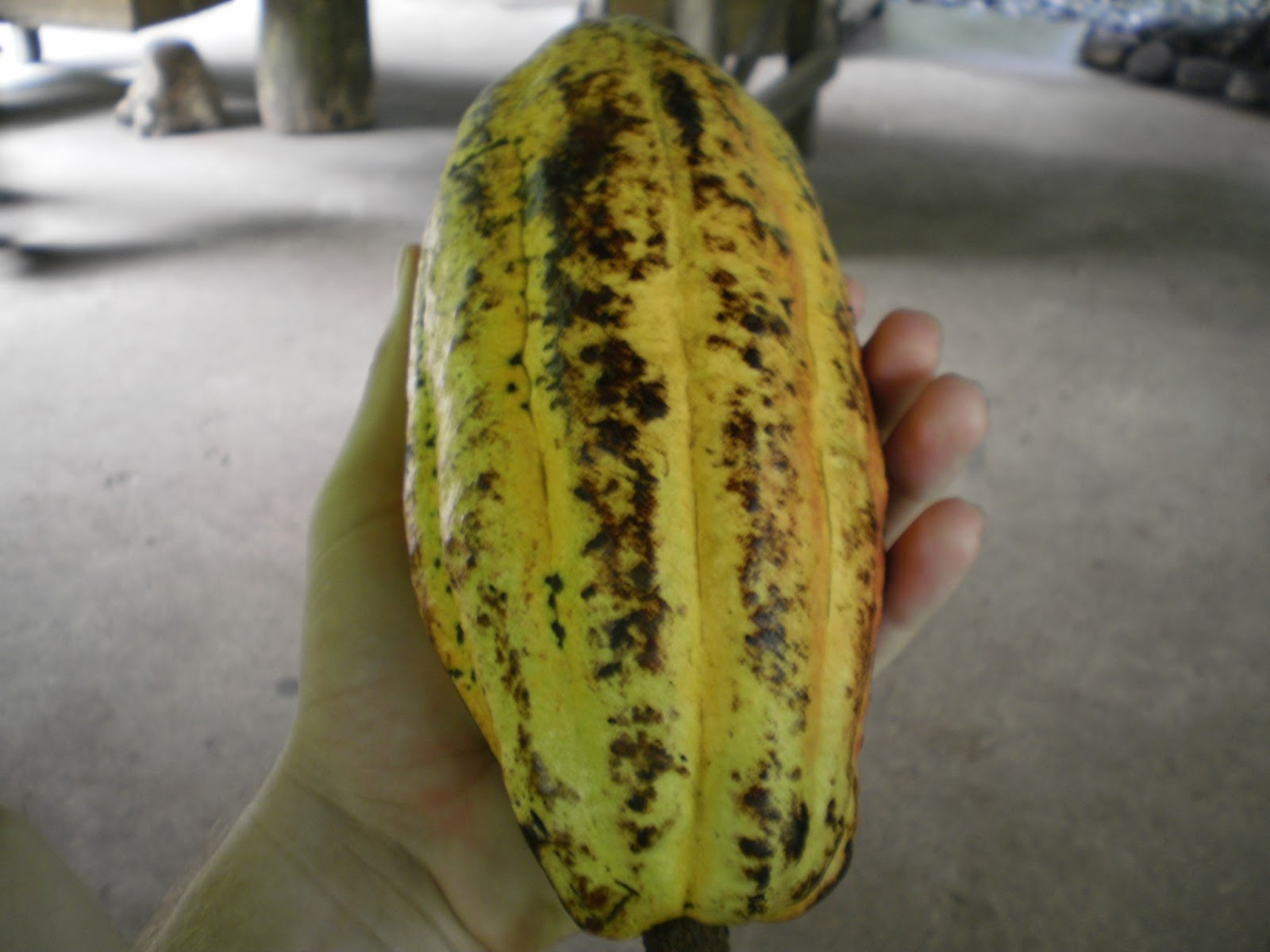
Fun fact: "cacao" and "cocoa" are exactly the same thing. Cacao is just the Spanish name for cocoa. Last weekend, I watched a demonstration of how this native Costa Rican plant was utilized by the indigenous population into chocolate products. Since fancy chocolate uses the original name and I just feel like I'm talking about Swiss Miss when I say "cocoa," I'll refer to it as cacao…

Cacao grows on a strange, bent tree with tiny pink flowers that turn into a hard, yellow, gourd-esque fruit. Cacao isn't the fruit, but rather the white seeds inside. The indigenous people believed that cacao was a gift from the gods. They believed it would be disrespectful to bust it open with an axe or the ground, so accordingly they used their foreheads or elbows to bash it. Originally, people found that sucking on the seeds had a slight mood-elevating, energizing effect (there is some caffeine present naturally). After they had sucked on it they would just toss it on the ground, contributing to the spread of the plant through Central America. They never ate the seeds because the inside is extremely bitter and even eating one seed will give you serious diarrhea. This is actually why it has the name it does. The Spaniards found out these side effects the hard way, so they gave it a name derived from "caca agua," literally "poop water" but meaning more like "watery poop."

Below is a video of my boyfriend bravely volunteering to eat a roasted seed. It won't destroy your stomach, but it still tastes awful.


Roasted seed
Through the habit of tossing the sucked-on seeds onto the ground, people discovered the benefits of fermentation. The saliva provided the anaerobic bacteria and water necessary to start the process, and left alone in the equatorial heat the seeds ferment quickly and have a very pleasant aroma. The lower social classes were expressly forbidden from utilizing this process, because cacao was considered sacred. The upper-class folk (kings, shamans, etc.) refined the seeds beyond fermentation. The seeds were then dried in the sun, roasted over a fire, and shelled. The insides of the shelled seeds are edible, but still way too bitter for me to handle more than a lick.

The insides were then put in a large, curved standing bowl—usually made out of volcanic rock. With a smooth stone heated in a fire, they spent 6-7 hours grinding the shelled seeds into a fine, dark-brown powder. The Spaniards brought mechanical grinders from Europe that really accelerated the process. This
powder can be refined into cocoa butter, or in different ways into chocolate. We tasted it at this stage with some raw sugar and cinnamon mixed in, and it was really good but still quite bitter.

The indigenous used this powder to make a chocolate beverage by mixing the powder with either hot or cold water (the Spaniards preferred milk). To flavor it, they would mix in some of the following: vanilla, nutmeg, black pepper, or chili powder. The indigenous favorite was vanilla and chili powder, and many students in my group liked it well enough. I went with vanilla, nutmeg, and some corn starch (to thicken it) myself, and it was definitely delicious.


From here, the refining of cacao was developed to make chocolate bars in the 19th century. Cacao has been cultivated at a modest scale in Costa Rica, but they technically don't make chocolate, because it isn't refined into bars here. According to one of my professors it is fairly low quality in global terms. 

Monday, June 24, 2013

Travel #4: Puerto Viejo

How to get to Puerto Viejo from San Jose           

Some websites—including Lonely Planet—say you can travel from San Jose to Puerto Viejo by taking a bus from Terminal del Caribe. Here's how to actually travel to Puerto Viejo: take the bus to Puerto Viejo from Terminal San Carlos—AKA Terminal Coca-Cola—which is about 6-7 blocks from Parque de la Merced—AKA "Managuita". It's fine to walk during the day, but I would recommend taking a cab in the evening. You want to take the MEPE bus, which is the line recommended by other sites. When I went in June 2013 the buses left at 6 AM, 10 AM, 12 PM (Sunday only), and 2 PM. The trip is around 5 hours long and costs $10 (might be cash only). Consider showing up about an hour early so that you know you get a ticket and aren't stuck waiting two hours for the next bus. Buy the ticket ahead of time only if you can be absolutely certain you're going to make your bus; the only thing worse than waiting 2 hours for the next bus is waiting 2 hours for the next bus after missing the trip you already paid for.

The bus ride isn't so bad despite being so long. It's like an American charter bus, but with no restroom or air conditioning. The bus will stop in Limón about 3.5 hours into the trip. There are decently clean restrooms for use for 150 colónes, as well as some little restaurants (I recommend an empanada de carne for a cheap snack). The bus stops again in a dirt parking lot in Cahuita, which is about 20 minutes before the last stop in Puerto Viejo. Some people prefer Cahuita to Puerto Viejo because the beaches are slightly less crowded and there is a lovely national park, but there are more accommodations in Puerto Viejo.

The beach & town of Puerto Viejo

Honestly I found myself agreeing with the Spaniards in that I much prefer the Pacific Coast. The beach vibe in the town of Puerto Viejo is cool and not exclusively for the gringo tourists (when I went there were more Ticos around). There are lots of souvenir shops and restaurants of different varieties and price ranges. A lot of the restaurants have Wifi, too. I've heard that the fusion cuisine in Puerto Viejo is awesome, but honestly I didn't get around to trying it since I ate at the same Italian pizza & pasta restaurant next to Rockin' J's twice because it was so good (owned by Italians). I noticed too that besides all the European ex-pats there are lots of Jamaicans, who originally were brought by the fruit companies that used to own and develop most of Limón as labor on the railroads and plantations. So, interestingly enough, loads of people speak English. It's Creole English, but I could understand it when I heard it.

The beach in Puerto Viejo is good for casual, laid-back swimming. Some areas are rocky, which makes it difficult to walk far out. I would think it's bad for surfing though, because there aren't many waves, and no big ones. Unfortunately the beach is pretty dirty from litter and plant material washed in from the ocean, plus litter from beachgoers, so make sure you have shoes and wear them until you are out of areas shaded by trees. Hookworm larva can get in your foot in those shady areas, but the sunlight on sand kills them.

Survival Tips/Travel Tips for Puerto Viejo

  • Withdraw a lot of cash for your trip. With the exception of some grocery stores, very few places will accept credit/debit cards. If they do, there will definitely be a fee (between 10% and $10) and maybe a minimum transaction amount (as high as $16 in one place). None of the small souvenir vendors will take cards, and few of the rental places will either. The ATM is about 2 blocks from the bus stop.
  • Don't walk around at night, especially alone. The U.S. Embassy sent an email out a few weeks ago about a slight increase in armed robberies of U.S. citizens in the Puerto Viejo area. This is because people think you have cash, and if you're trying to buy anything anytime soon, they're right. Sun sets around 6 PM, and it would be a poor choice to walk around after that without a group of at least 3 people, or at all after 8 PM. There are taxis everywhere (official "rojos" and the "piratas"), just do that if you need to bar hop.
  • Bring bottled water. The water outside of the Central Valley (provinces of San Jose, Alajuela, Cartago, and Heredia) is not safe to drink. You can maybe risk small amounts to brush your teeth or something, but you absolutely must have bottled drinking water. I would buy it ahead of time, because it's expensive there since people know you have to buy it.
  • Bring bug spray, with lots of DEET (though I think over 40% is dangerous even for humans). There are lots of bugs (mosquitoes) all over Costa Rica, but especially at the beach, in greater number and variety. There is also a higher risk of contracting a tropical disease from an insect in the coastal regions, especially on the Caribbean side of Costa Rica. One of the biggest worries is dengue, which has increased 300% this year (read an article here).

My review of Rockin' J's Hostel

If you're looking for specific information about the rates and stuff at Rockin' J's, you can see their website here: . Basically you have four options (in ascending order of price, though it's all cheap): hammock hotel, tents, dorm, private cabina.  It tends to receive rave reviews from everything including the Lonely Planet guide site, but here's my description of the accommodations:

Hammock: You couldn't pay me to sleep in those hammocks. They're covered from rain but there is almost zero bug protection, and little air circulation besides a few oscillating fans. I can't imagine they are washed frequently, and certainly aren't between individual customers. You might as well pay the extra $2 to get a tent and not get malaria. 

Tent: The tents are just normal 2-person camping tents, which are decently large vertically and horizontally. Inside is a double mattress (with sheets). Since you can't lock a tent, the staff will assign you a large locker for your stuff that you want to put away. I wouldn't worry about theft there, but obviously better safe than sorry. You can also camp there for hardly any charge if you bring your own tent (though there isn't much grass to put a tent on, but plenty of gravel).

Cabina: The cabinas go from one bed to 4, and there are "suites" that have room for 6. All that's in there is the selected number of bunk beds (with sheets), an oscillating fan, and lights. They have a window, which you'll want to leave open for air (and unfortunately, bug) circulation. I stayed in the "observatory" cabina built on top of one of the hammock areas, which was cute and more spacious but was not completely protected from rain and only partially from bugs.


Overall: All the mattresses have sheets and pillows, though if any rain or much humidity has gotten inside the place they will feel mildewed and even damp. If this is the case, you can ask the staff to replace them with a more recently cleaned set. The water is cold and not safe to drink. I'm not certain how it's safe to wash dishes/clothes/hands in non-potable water, but whatever. If you want to completely isolate yourself from it, the hotel has clean water you can use to refill empty bottles for fairly cheap (~1000 colones for 1 litre). There is Wifi, but only in the table areas downstairs, near the restaurant. There are also plugs there to charge electronics, and inside the cabinas. The restaurant/bar has good food from 8 AM to about 11 PM, but pricey. Another reason to have cash: there is a $10 fee if you try to pay with a card.

Monday, June 10, 2013

Tortugueros vs Ecoactivists: Consumption of Sea Turtle Eggs in Costa Rica

On the 1st of June, 2013, Jairo Mora Sandoval was ambushed and murdered by people trafficking the eggs of endangered sea turtles in the Limon province (on the Caribbean coast) because he was guarding nest sites. [Full news article here] Since then, the Costa Rican media has lit up with debates about ecoactivism and the prioritization of protecting wildlife. So, why are sea turtle eggs worth murdering for in Costa Rica?

Originally, the Africans imported as slaves from Jamaica to the Caribbean coast ate turtles and turtle eggs (typically with coconut oil) as a traditional dish. One of my professors lived in Limon as a child and said that his grandmother would frequently serve him such dishes, and that he'd be lying if he said it wasn't tasty. In addition to the traditional consumption, there is also its use as a home remedy (very popular in Costa Rica, since you have to wait months or even years for certain medical treatments) as an aphrodisiac for increased sexual appetite and performance. The cultural importance of an aphrodisiac, even from an endangered animal, is not that unusual; in East Asia people frequently deal crushed rhino horn for such use.

Since there is that market, there are always people willing to cater to it. There are people (also usually involved in drug dealing, for whatever reason) called "tortugueros" who go to the beaches at night to dig out the sea turtle nests and remove the eggs. Each egg gets about $1 American/500 colones for the tortuguero, and sells to a normal person for at least $2.50. At this rate, tortugueros can make about $80 per night.

Naturally, just because it is cultural or traditional does not mean it's ok, and of course the government understands that (tampering with nests and consumption of endangered turtle eggs is illegal). Some people here take the perspective that problems like this are a giant hypocrisy of Costa Rica (as I read in an opinion piece in La Nacion on June 7th). Others understand the cultural background but don't partake now because they care more about the environmental ramifications of the egg consumption (like my professor). Still others are just trying to make money. All in all, it's a really interesting mix of perspectives and priorities that is something every country has to face when it decides how to protect its natural resources.

Monday, June 3, 2013

Third World?

The term "third world" was coined in the Cold War, and was used to describe countries that didn't prescribe to capitalism (first world) or socialism (second world). I always thought the divisions were based on the wealth of the nation! According to the UN, there are three types of country based on safety and health of living: developed, developing (Costa Rica), and underdeveloped. Their GDP per capita is approximately 1/4th the size of the U.S.'s. There are 4.7 million people in an area about 5/6 the size of West Virginia. The poverty rate is about 23%. But the question remains: what is the quality of life in Costa Rica? Is Costa Rica poor?

A new measure called the Happy Planet Index describes Costa Rica as the happiest nation on Earth. They give scores to countries that combine their ecological footprint, life expectancy, and experienced well-being of inhabitants (includes reported happiness, education, etc.). The U.S. is ranked 105th out of 151, almost entirely because the quantified ecological footprint score is 3 times higher than Costa Rica's; the life expectancy is 0.8 years lower, and the experienced well-being is 0.1 points lower. This measure tries to have a different take on the world than the GDP, which assumes that wealth is the only/best measure of success.


Observations

There are some things that, as an American, seem very strange to be without. For example, most people have a washing machine, but nobody has a dryer—everything dries in the open air (despite the almost daily rain). My host mother told me it's because they use so much energy. Some families have a car or motorbike, but rarely use it—you can get most places easily by bus or on foot. My host family has one car, which is owned by a son who uses it to drive to work. Except perhaps for the very wealthy in this equatorial nation, nobody has air conditioning. Many businesses have it, especially the American brands (Walmart, Pizza Hut), but people at home prefer to leave windows and doors open for the air to circulate. Most of the time you don't really need it, but I'd be lying if I said I didn't miss it when I was trying to go to sleep! It's also very common for people to share bedrooms and house people for extended periods of time. In my host mother' sister's home there are two children who come and go throughout the week, but extra mattresses around for 4 more. Currently there are two past exchange students visiting there, one of whom is staying for several weeks. In my boyfriend's host home, a friend of the daughter's is staying in a spare bedroom for an extended period. It's unarguably cheaper for the guest than hotels/apartments, and I get the feeling that Costa Ricans really enjoy full houses and guests.

4-patty double Big Mac for $3
And again, as an American, there are plenty of things that surprise me to see in a "third world country." I see so many people with smart phones, with probably as many being clutched by people on the bus as I might see in the U.S. The malls here are nicer than any I have ever been in elsewhere. Many products in those malls are as expensive or more expensive than they are in the U.S. (being imported really adds to the price). There are also a good deal of people with expensive road bicycles (the sort you would race), that easily run at least $1,000. People also eat out a great deal, similar to the U.S., but fast food is rarely the cheap option here. Our resident director told us that when he grew up, it would be a special treat at the end of the week for him and his siblings to go to McDonald's if they behaved. Another professor told us that it's stylish to eat at the fast food restaurants, and even a bit trendy to be fat for doing so.

Edit: something I totally forgot to talk about earlier was health, which I should totally remember to talk about! In 2005, the 5 most common illnesses in Costa Rican men were: alcohol dependence, car accidents, breathing problems, and HIV/AIDS. In women they were: rheumatoid arthritis, breathing problems, asthma, depressive disorders, and HIV/AIDS. There are also annual problems with dengue, malaria, and diarrhea, when the rain comes. When I say the rain comes I mean pretty much daily Old Testament-style downpours, so it's easy for water to become stagnant and a lovely breeding ground for mosquitos. Costa Rica has one of the best healthcare systems in the Americas, and spends 1/15th of what the U.S. does on healthcare. It's had socialized medicine since the 40s, and while effectively every resident is covered in the public system, people die on the waiting lists. For example, in the U.S. my little brother was diagnosed with a congenital hernia when he was about 5-years old. He was in surgery the next day to repair it. My boyfriend's host dad here was diagnosed with a hernia last September and has to wait for years for the surgery, because the system is so overloaded. I have read that the only things people are reliably on time for here (I haven't verified this myself) are movies, work, and doctor's appointments.

This is perhaps a small reflection of lack of resources: if there were more money they could have more doctors and hospitals, and the waiting lists would be manageable. But it is also a signal of the main topic of discussion between Costa Rican President Laura Chinchilla Miranda and President Obama a few weeks ago: the emigration of educated Costa Ricans. School is mandatory here, and public school is free through high school like in the U.S. University education is extremely cheap, but graduate school is neither cheap nor very diverse in the available fields of study, so many graduate students go to the U.S. and don't return. President Chinchilla was asking a lot about how to ensure that educated Costa Ricans stay in Costa Rica to contribute to society.

Conclusions

In the end, obviously "third world" is the wrong label if you're trying to understand the quality of life here, because whether the country is capitalist or socialist has at best, only a loose correlation with what we're actually wanting to know. There is definitely a lower standard of living here than in the U.S., but that's true of very many countries. I don't feel like I'm "roughing it" here. There are a few creature comforts missing, but it is difficult to say that the Costa Ricans are really missing out on anything when they have different priorities. 

Wednesday, May 29, 2013

Travel #3: Cartago

The next day trip our group took was to the neighboring province of Cartago. First we stopped at the Colonial Church of Quircot, a 15th century Franciscan mission that is thought to be the oldest church in Costa Rica. Because it's Franciscan, it has architecture very similar to many mission-style churches in California. This building is notable because it is one of the few original mission-era buildings that has survived constant tectonic tremors, frequent earthquakes, and occasional floods over the years.

The main purpose of these missions was to convert the local populace to Catholicism. Obviously when the monks arrived everyone did not conveniently already speak Spanish, so for a few generations all evangelism was done through art. Art was used in paintings as well as in published texts. The stations of the Cross are framed around the entire chapel (pictures here), and the ancient Bibles are full of opulent illustrations. Note that in the paintings, Jesus and other important figures are depicted as very fair-skinned. This is less because of the popular claim that the Franciscans thought Jesus was of European heritage, and more because the white was used to indicate purity and vulnerability to God.

Another very interesting set of symbols is in the depiction of the Virgin of Guadalupe, who is one of the most revered religious figures in Catholicism. The exact image of the Virgin was targeted by the religious authorities of the time to appeal to the very prominent Aztec religion in Central America. The rays of sunlight emanating from all around her reach to the worship of the sun, the stars on her cloak to the worship of stars, and the blue of her cloak to the prominence of the color blue as a religious symbol (as red is often a symbol in Christianity for the blood of Christ).

While driving, we stopped at a scenic overlook to see some coffee plantations in a valley. Costa Rica has legislature now that forbids cutting down more jungle to make space for coffee plants—something that is now decimating forests in much of South America. The very finite supply is what makes Costa Rican coffee a bit more expensive. There are two types of methods for growing coffee that supposedly create a minute taste difference: shaded versus unshaded. For shade, people plant tall, thin trees among the coffee beans.


Unshaded coffee plants

Shaded coffee plants

Our last stop was the Basilica of Our Lady of the Angels (la Basilica de Nuestra Senora de los Angeles), the largest basilica in Costa Rica. It has beautiful decor and architecture, but I felt so bad about disturbing worshipers that I left before I could take many pictures.


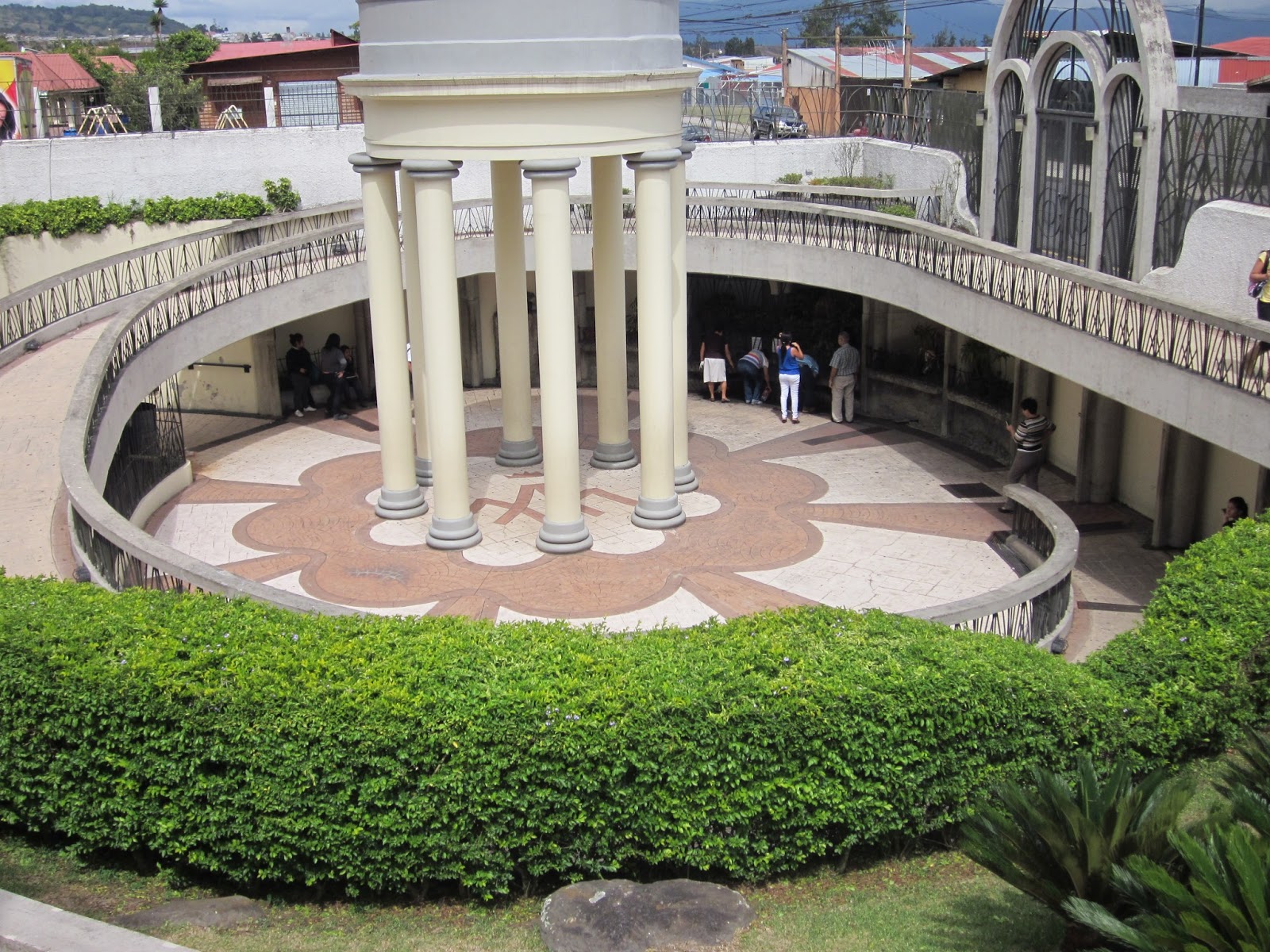
One of the traditions I unwittingly interrupted was people appealing to the Virgin. When they have an extra important problem, worshippers will walk down the main aisle of the church on their knees, praying about it. Sometimes people will walk much further than that on their knees as a pilgrimage. On August 2nd every year, thousands and thousands of people will make pilgrimages on their knees from their home to this church as a special holiday honoring the Virgin, some from outside Costa Rica. I don't know if this tradition takes place elsewhere too, but if the special request was granted, worshipers will bring a tiny silver charm (called exvotos) representing the nature of their problem and leave it as a gesture of thanks. Below the basilica is a large walkway with walls covered in these tiny silver arms, houses, etc.

One of the more interesting exvotos was left by a young man who fell from a tree and was stabbed by a stick on his way down, and in gratitude for his health he left that very stick.


Finally, there is also a holy spring next to the Basilica. During the holiday honoring the Virgin, thousands of people bring tiny bottles to save some of the holy water for themselves or to bring to family members. On a regular day, there were two dozen people at the spring (though some were just drinking from it). The legend behind the spring is that on August 2nd (the holiday) of 1635, a native girl named Juana Pereira was collecting firewood in the area that the Basilica now sits on and found a small doll-like statue on a large stone. Being a little girl, she took the doll home. The next day she returned to the same place, again for firewood, and saw another doll-like statue. She took it, too, and was amazed when she returned home when the doll from the day before was gone. This happened again the next day, and when she informed a priest he told her it was a miracle, that the nearby spring is therefore holy, and so they built a church there. 

Tuesday, May 28, 2013

Stations of the Cross

Below are all the photos from the stations of the Cross, which tell the story of the Crucifixion, as posted in la Iglesia Colonial de Quircot.


Tuesday, May 21, 2013

Travel #2: INBioparque


Tree of life
Our next excursion was to visit Costa Rica's smallest national park: INBioparque, which has segments that demonstrate both wet and dry forest, as well as areas to show their work with butterfly and mushroom breeding. The approach that Costa Rica takes is very interesting, and quite distinct from in the U.S. Here they interfere very little with the natural flow of events. If a tree falls or is covered in a lethal vine, they leave it alone unless it affects the walking path. If an animal is sick, to my understanding it remains sick unless it recovers independently. There appears to also be much less data collection except things that are exports; for example, in many American national parks they track packs of wolves and the like for research.

Our tour guide Diego (seriously) first showed us a gigantic tree that was known to the Aztecs as the tree of life. They would frequently bury people at its roots to offer it nutrients, and if the person was especially important they would be buried inside a hole cut into the tree.

This one is popular in offices
The rest of the tour was mostly just a gigantic photo op, and Diego pointed out many different types of plants (which are frequently cultivated and exported for decoration) and animals (mostly iguanas, birds, and one bored horse) that live in the park. Costa Rica has 5% of the globe's biodiversity, which sounds small but is really not 

Well there aren't alligators in Costa Rica, just crocodiles


Male iguanas turn orange like the one on the right to attract females


Me and the elephant ear plant, which has the second largest leaves in the world.
The plant with the largest also grows in Costa Rica, but not in INBioparque.


One of the many birds that Diego told us about was the Costa Rican national bird, the Clay-colored Thrush, which is a very plain brown bird that has beautiful, complicated songs. It's sort of like the Susan Boyle of birds. The songs are so varied that in ancient times, crop planting and harvesting would be marked by the seasonal changes in the bird's songs. The legend behind its appearance goes that this bird used to have exquisite feathers, but couldn't sing. He was so jealous of all the other songbirds that he asked Quetzalcoatl (indigenous deity) to be able to sing. His wish was granted and he became the best singer of all the birds, but the price was his beauty. So to Costa Ricans he represents the value of hard work.

Later we visited the butterfly sanctuary, where chrysalises are bred, researched, and exported for weddings and biological research outside Costa Rica. The butterflies that are present in people's backyards are the sort of things that appear extremely exotic anywhere else, and they're a big part of the ecosystem here. My boyfriend's host dad here has many bushes of a particular plant (milkweed, maybe) for the sole purpose of being food to enable caterpillars to grow into butterflies. Walking among them you can see many empty chrysalises, a few caterpillars scooting around, and several bushes that have been consumed down to the stems by previous residents. I'm sure some of you read the children's book "Hungry Hungry Caterpillar;" they may not eat pears or watermelons, but they are definitely hungry hungry...
Monarchs here don't migrate like those in North America do. They already have
everything they need here, so that instinct does not drive them to leave.


One of the last things we accomplished on our tour was finding a three-toed sloth, which was much more difficult than you might think since from the ground they look like little fur balls sitting like growths up at the treetops. Sloths are very strange animals... They eat flowers and fruits from the trees, and sleep for about 18 hours a day (they nap throughout the other 6). Every 7ish days they climb down to the ground to defecate, allowing a really interesting example of symbiosis to occur. There are many bugs and beetles that live in its fur. When it comes down to the ground to poop, many of the beetles hop off of the sloth, lay eggs in the feces, then catch up with the sloth later. Beyond that, there is also a photosynthetic algae that lives in its fur, which gives it its greenish color and lets it blend in with the trees. It's important for it to hide from predators because besides hiding, it's a pretty vulnerable animal. It is extremely light (you could hold an adult with one finger) and its bones are hollow to allow it to perch on thin branches. But, this also makes it easy for jaguars and harpy eagles to carry it off, so hiding is the best option.